Key Takeaways
- There are three ways to get GTM engineering done: hire in-house, hire a GTM engineering agency, or hire a lead generation agency because the problem is pipeline, not systems.
- Which one fits depends on two variables: how much building you need, and whether the work is one-time or ongoing.
- GTM engineers cost $132,000 to $241,000 according to Apollo’s salary guide, and more at senior level, plus tooling and three to six months of ramp before the first build ships.
- Most agencies calling themselves GTM engineering build automated outbound. A smaller group builds revenue infrastructure. Those are different jobs and the label does not distinguish them.
- If your systems already work and you need more conversations, buy lead generation and skip the rest of this.
Which of the three ways to get GTM engineering done suits you comes down to two variables: how much building you need, and whether that work is one-time or ongoing.
The three options, defined
Your three options are a full-time hire who builds on your stack, an agency that builds and leaves, and a lead generation agency that sells meetings.
An in-house GTM engineer learns your stack and is available for small requests. Their knowledge stays with them, which pays off for as long as they stay.
A GTM engineering agency gives you several specialists instead of one generalist, and they leave when the build is done. Some of these firms build outbound systems and some build revenue infrastructure.
A lead generation or outbound agency builds lists, runs campaigns and hands over appointments. What you buy is meetings. Don’t confuse this for a build, it can be an expensive mistake.
GTM engineering agency vs. in-house vs. lead gen: the comparison
An in-house hire is cheapest per unit of work when the work never runs out, an agency is faster and broader for a bounded build, and a lead gen agency solves a different problem entirely.
| In-house hire | GTM engineering agency | Lead gen agency | |
|---|---|---|---|
| What you get | One person, deep on your stack | A team, broad across platforms | Meetings and contact lists |
| Cost structure | $132k to $241k salary (Apollo), plus payroll, tooling and equity | Project fee or retainer scoped to the build. No agency in this category publishes rates | Monthly retainer, often priced per meeting |
| Time to productive | 3 to 6 months, hiring and ramp combined | Days to weeks | Weeks, once lists and copy are ready |
| Stack breadth | One or two platforms well | Many, because they work across clients | Outbound tooling only |
| Who owns the build | You | You, if the contract says so. Ask. | Nobody. You rent the output |
| When they leave | Knowledge leaves with them unless documented | Documentation and handover, if you specify it | Campaigns stop immediately |
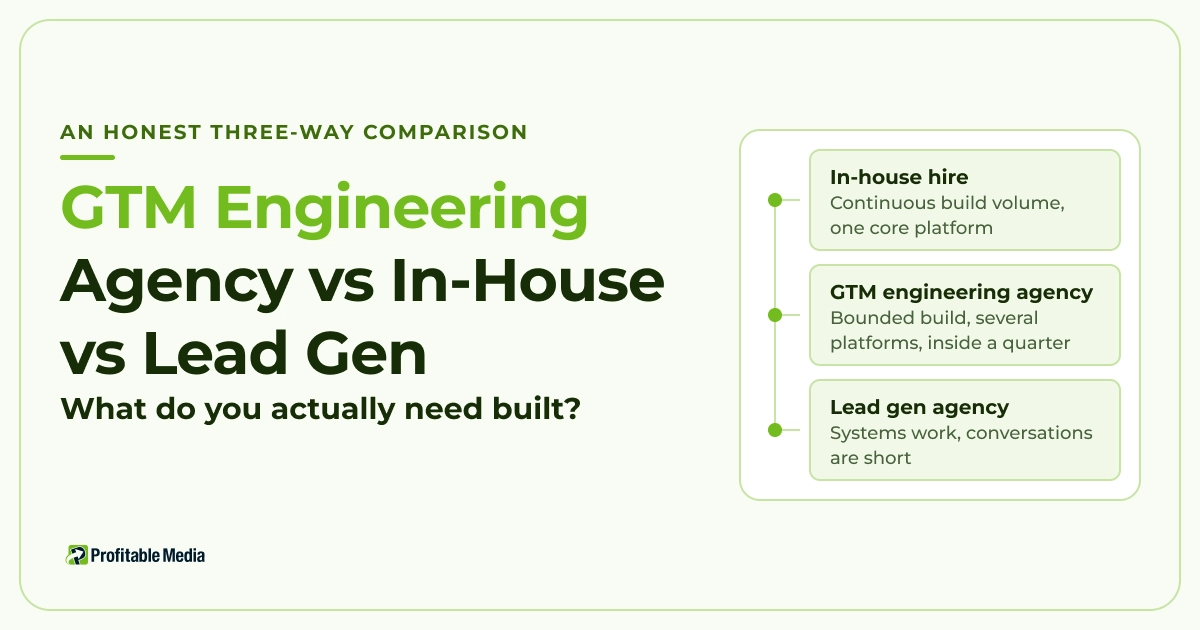
| Best when | Continuous build volume on one core platform | Bounded build across several platforms | Systems work, conversations are short |
When hiring in-house is the right call
Hire in-house when you have continuous build volume, one core platform, and three to six months before you need results.
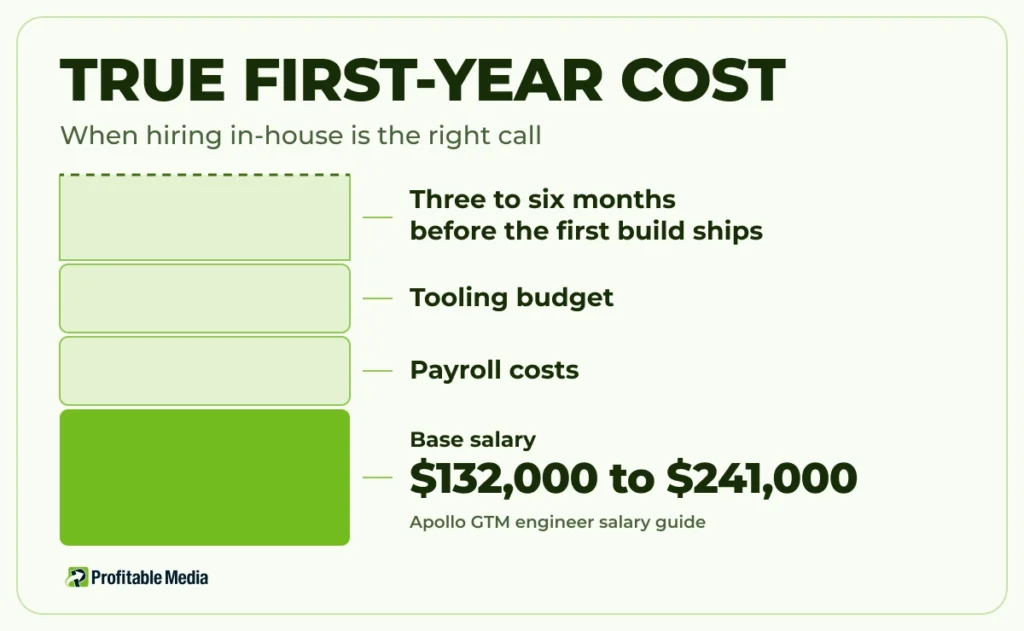
Apollo’s GTM engineer salary guide puts the range at $132,000 to $241,000. The first year costs more than the salary line suggests, because payroll costs, the tooling budget, and three to six unproductive months all land before the first build ships.
With eighteen months of building on the roadmap, an employee builds up context that nobody has to re-explain — something no outside team’s engagement can replicate. It stops working when the build is finite. A GTM engineer with nothing left to build becomes an expensive operator.
When a GTM engineering agency is the right call
An agency suits a bounded build that spans multiple platforms and needs to ship within a quarter.
A single hire knows one or two platforms properly, but a build with a CRM, a payment processor, a fulfillment system and an analytics stack needs someone who has shipped on all four. That person is hard to hire. But an agency can easily achieve this, and they can start within days.
An agency can also leave. If the contract does not specify documentation, credentials and a handover, you have bought a system nobody at your company understands. To fix that get a contract specifying what documentation and handover looks like.
When you want a lead generation agency instead
If your systems work and the shortage is conversations, buy lead generation.
Some businesses have a clean CRM, reconciled tracking, billing that never fails, and too few people at the top of the funnel. GTM engineering has nothing to sell that business. Adding infrastructure to a working stack produces a nicer diagram and no revenue.
Pull your last ten lost deals. If they died because you never got the buyer on the phone, that’s a pipeline problem. If something in your systems dropped, mis-tracked, or mis-billed them along the way, that’s on us.
The distinction most of this market blurs
Most firms using the GTM engineering label sell outbound, and a smaller group sells revenue infrastructure. Those are different products behind one name, which is why field guides and agency FAQs keep answering whether a GTM engineering agency is a cold email shop rebranded.
The GTM engineering agency field guide at getaob.com, written by Garrett Wolfe of OneGTM, maps the market into five segments: GTM engineering and outbound agencies, outbound and lead generation agencies, RevOps consultancies, Clay agencies, and AI-native practitioners. It covers lead sourcing and outbound execution in depth and does not substantively cover revenue infrastructure, CRM architecture, billing, or attribution.
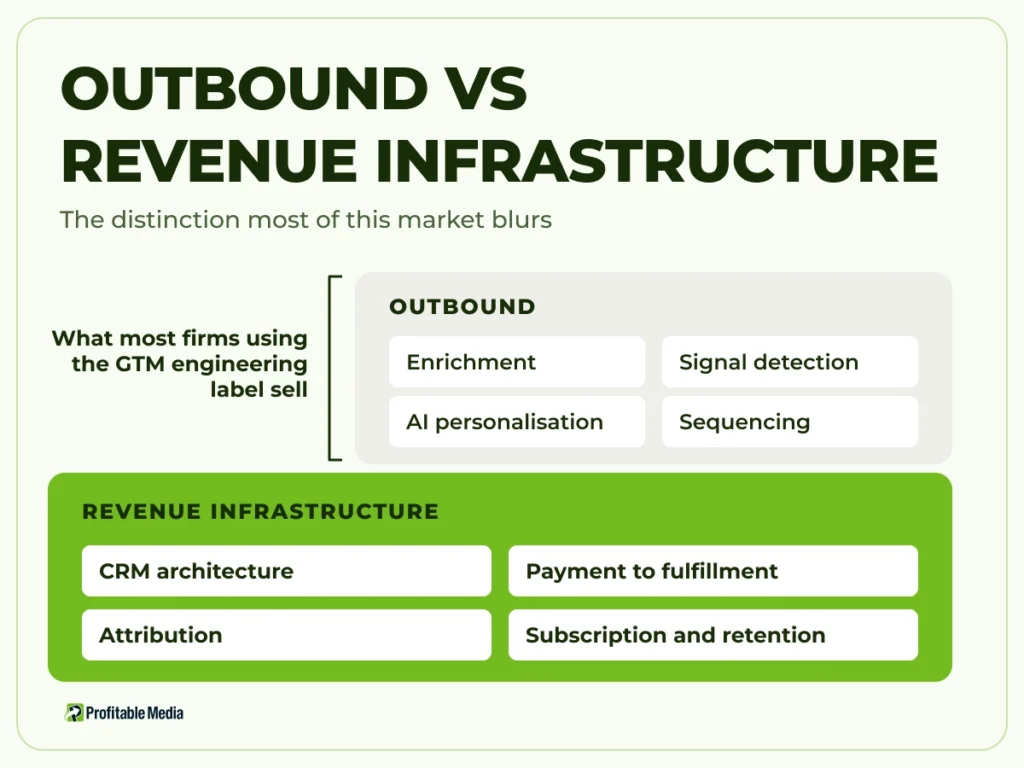
On five competitor sites (Nebor, GTM11, RelayPush, ThynkGrowth and DrJoe), the answer to the cold-email question came back the same. A lead gen agency sends campaigns, while a GTM engineering agency builds an automated pipeline system out of signal detection, enrichment, AI personalisation and sequencing.
That is a real distinction. It is also outbound measured against better outbound, the same job at different levels of sophistication.
Profitable Media builds the revenue infrastructure underneath go-to-market: CRM architecture, payment-to-fulfillment data flow, server-side tracking and attribution, and subscription and retention systems.
Outbound results decay because channels saturate and tactics get copied, so the same sequence returns less each quarter. Infrastructure has no equivalent exposure, because nobody else’s activity degrades your billing logic or your attribution.
What GTM engineering costs, in structure rather than numbers
Four things move the number:
- How many platforms are involved. Two systems talking is a small job. Six systems, however, is much bigger.
- How much data has to migrate. Weeks go into reconciling records that three different teams entered under three different conventions over five years, not into moving them.
- Whether the integrations need custom work. Where two mainstream platforms already have a native connector, the work is configuration. Custom API middleware between a payment processor and a fulfillment house needs engineering, and it is priced as such.
- Whether an existing build has to be untangled. Nobody can price the diagnosis of somebody else’s undocumented automation without opening it first, and any firm quoting it unseen is guesswork.
A scoping call should end with a written number tied to a named deliverable, not a range and a promise to firm it up later.
How to evaluate a GTM engineering agency
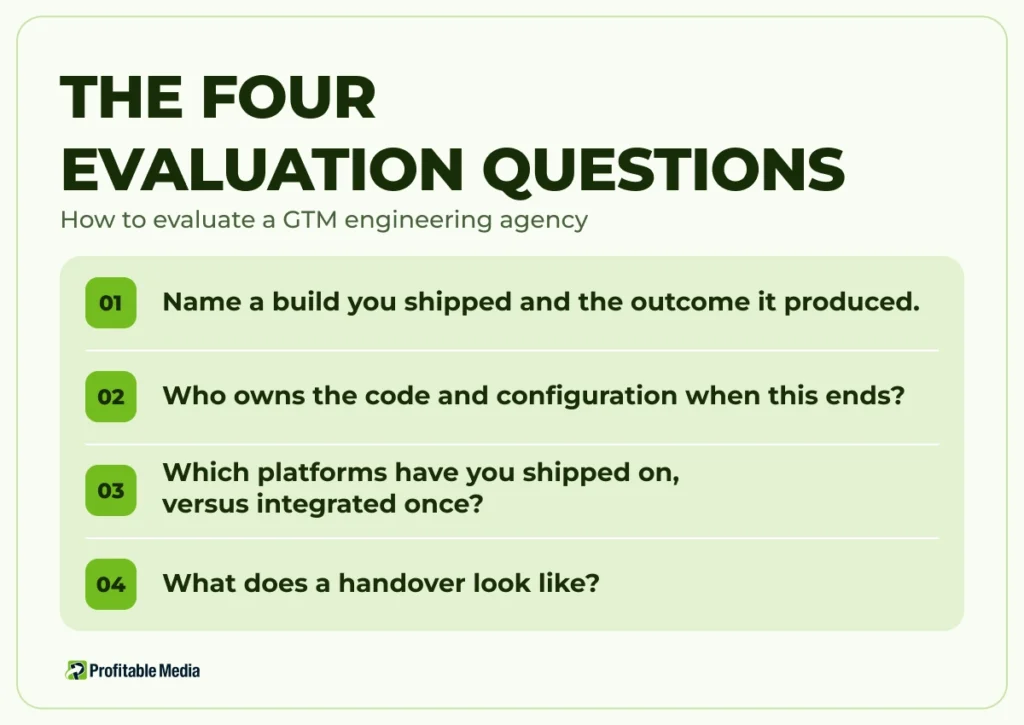
Name a build you shipped and the outcome it produced. If the answer stays at “we helped them scale,” they sold strategy and somebody else did the work.
Who owns the code and configuration when this ends? The answer should be you, in writing, including credentials, documentation and any custom middleware.
Which platforms have you shipped on, versus integrated once? A logo on a website means somebody there has seen the platform. Ask how many builds on each.
What does a handover look like? You want a date, a document, a walkthrough, and a support window.
Our answers to those four are on the GTM engineering services page.
What to do next
Book a 30-minute GTM systems roadmap call. We review your stack, tell you what has to be built, and you leave with a scope and a price. Standard builds take 4 to 6 weeks. Complex migrations across several platforms take 8 to 12.
If you need someone to run your existing systems rather than build new ones, get marketing automation support instead.
Frequently Asked Questions
How much does a GTM engineering agency cost?
Agencies in this category do not publish rates, and neither do we, because scope varies too much for a number to mean anything. Four things drive the cost: how many platforms are involved, how much data has to migrate, whether the integrations need custom API work or a native connector exists, and whether an existing build has to be untangled first. Ask for a written quote against a named deliverable before signing anything.
How much do GTM engineers get paid?
Apollo’s GTM engineer salary guide puts the headline range at $132,000 to $241,000, with juniors nearer $100,000 to $130,000 and its senior band running higher still, to $250,000 and above. Its own posting for a revenue operations GTM engineer lists $155,000 to $175,000. Budget payroll costs and tooling on top, plus three to six months of hiring and ramp before the first build ships.
Is a GTM engineering agency different from a lead generation agency?
Less often than the labels suggest. Most agencies using the GTM engineering label build automated outbound systems: enrichment, signal detection, sequencing. A lead generation agency runs the same motion more manually. Both sell pipeline, and only the method differs. A smaller group builds revenue infrastructure instead, meaning CRM architecture, billing and attribution, which is a different job. Ask which one you are talking to.
What is the difference between a GTM engineering agency and a consultancy?
A consultancy tells you what to build. An agency builds it. The field guide at getaob.com describes RevOps consultancies as strategy-heavy and build-light, which matches what we see. You get a documented recommendation and an implementation plan, and you still need someone to write the code. Ask any firm whether the deliverable is a document or a working system.
Author
Dylan Jones is Operations Manager at Profitable Media, where he works on stack selection, platform migration and funnel strategy for ecommerce, DTC and direct-response clients. Profitable Media has been building revenue infrastructure since 2008.