By Dylan Jones, Operations Manager at Profitable Media.
Key takeaways
- Merchants need fraud screening that can tell a verified AI agent from a bot, because the merchant still carries the chargeback on an agent order. Mastercard applies its standard dispute rules to agent transactions, and the Visa Rules protect the cardholder’s right to dispute an agent purchase.
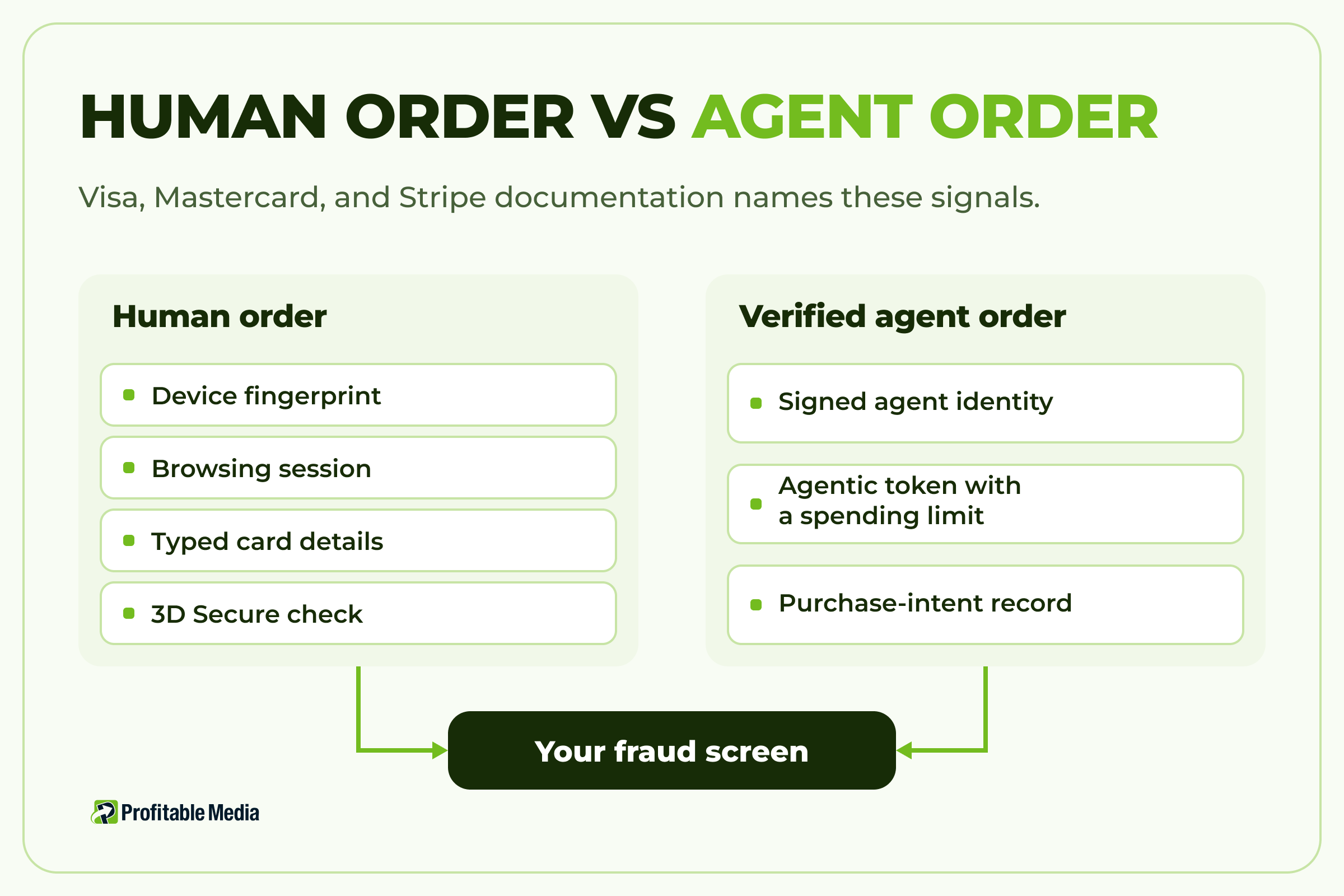
- A verified agent order arrives without the buyer’s device, browsing, or 3D Secure data. It carries a signed agent identity, an agentic token, and a purchase-intent record instead.
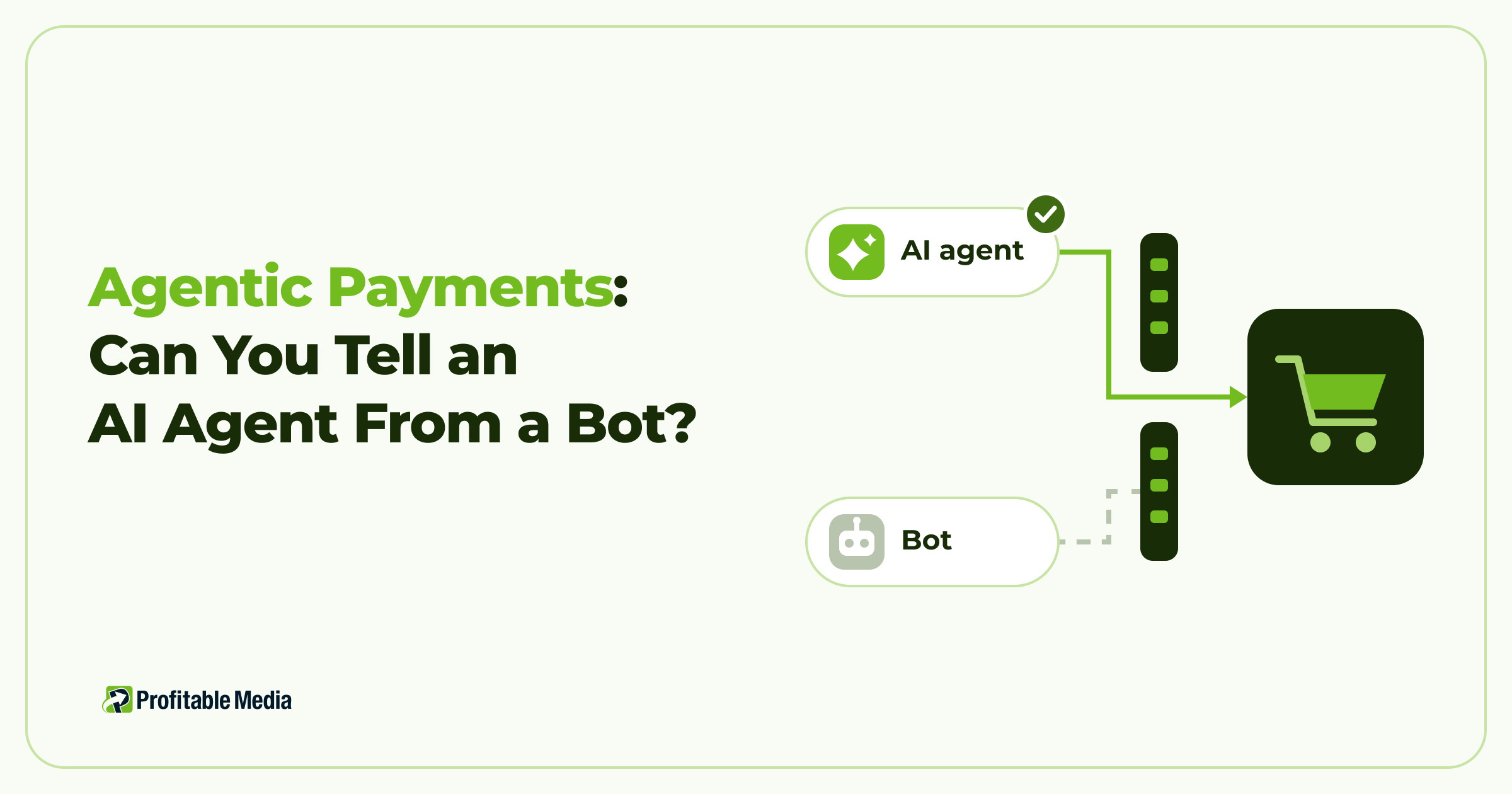
- Fraud rules that expect a human shopper get agent orders wrong in both directions. They decline verified agents for missing human signals, and without a signature check they can’t tell a registered agent from a bot using an agent’s name.
- The merchant’s best dispute evidence is the agent data that arrives with each order, because the cardholder’s consent record stays with the agent provider. The agent provider also holds the trial consent, and the merchant still owes the trial reminder before the first full charge.
- Brands on their own payment stack have to set up the agent checks themselves. Shopify and Stripe build the agent connections for their merchants.
An AI agent’s payment now reaches your checkout like any other card payment, and your fraud screen has to decide in a fraction of a second whether a real customer stands behind it. Fraud rules for human shoppers look for a device, a browsing session, and a 3D Secure check, and an agent brings none of them. A screen that can’t read what an agent brings instead will turn away paying customers or approve bots posing as agents, and the chargebacks stay yours either way. Profitable Media sets up and maintains fraud screening for merchants on their own payment stacks. See our payment fraud protection work.
What are agentic payments?
Agentic payments are purchases that an AI agent makes for a person with a payment token in place of a card number. The person decides what to buy, from which store, and the most to spend, and the payment token carries those limits so the AI shopping agent can’t go past them.
OpenAI’s Agentic Commerce Protocol gives the merchant a token with a maximum amount, an expiry time, and the merchant’s own ID. Stripe scopes its Shared Payment Token to one merchant and one cart total. The merchant charges the token through its own payment processor, as it would charge a card.
What has launched so far?
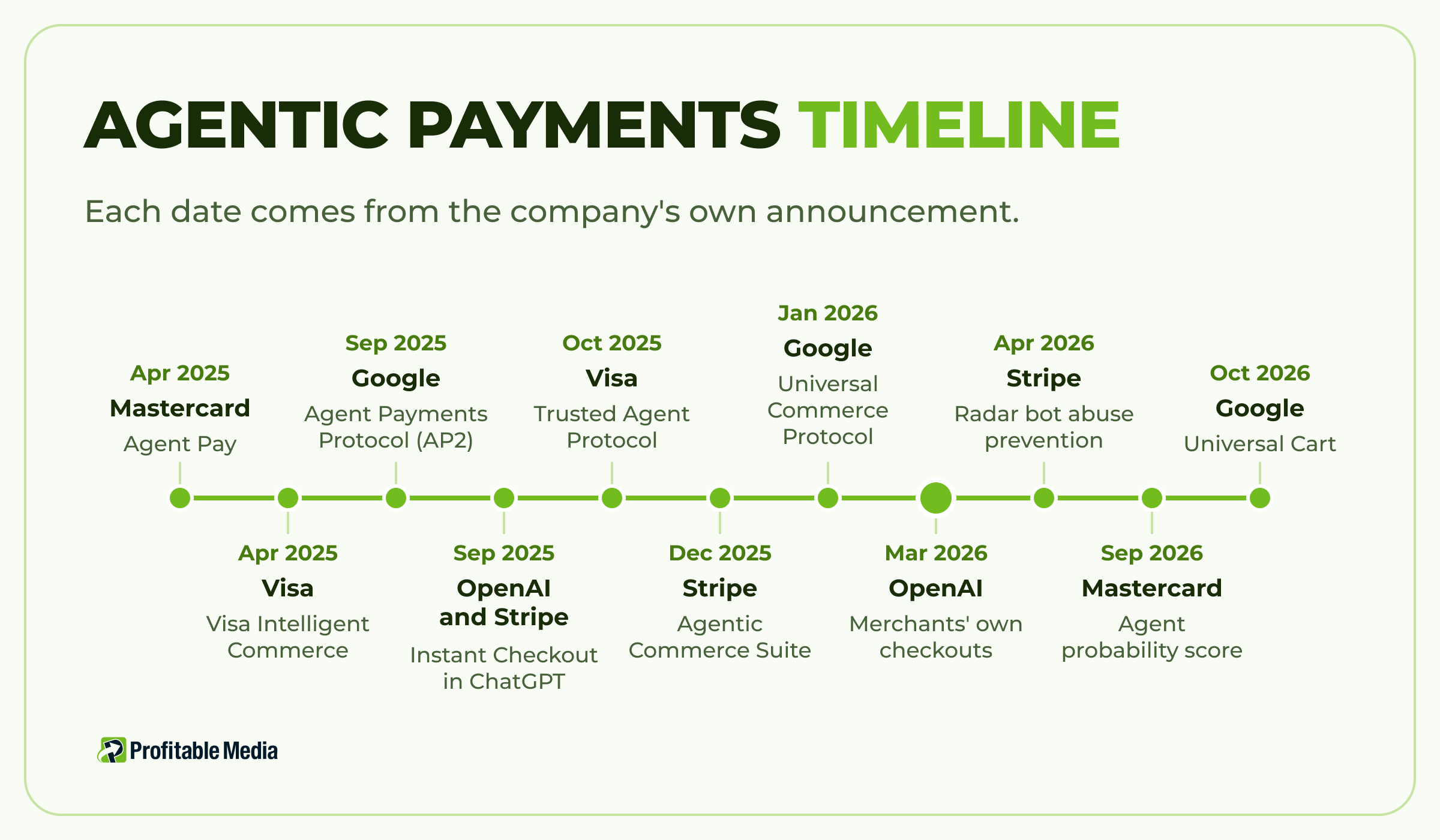
Since April 2025, Visa, Mastercard, Google, OpenAI, and Stripe have each launched a system for AI agents to pay:
| Date | Company | What launched |
|---|---|---|
| 29 Apr 2025 | Mastercard | Agent Pay, with agentic tokens that only registered, verified agents can use |
| 30 Apr 2025 | Visa | Visa Intelligent Commerce, with tokenized cards for AI agents and spending limits the shopper sets |
| 17 Sep 2025 | Agent Payments Protocol (AP2), with signed mandates that record what the shopper approved | |
| 29 Sep 2025 | OpenAI and Stripe | Instant Checkout in ChatGPT, the open Agentic Commerce Protocol, and Stripe's Shared Payment Tokens |
| 14 Oct 2025 | Visa | Trusted Agent Protocol, which Visa built with Cloudflare so a merchant can check an agent's signature |
| 11 Dec 2025 | Stripe | Agentic Commerce Suite, one integration for selling through several AI agents |
| 11 Jan 2026 | Universal Commerce Protocol, which Google developed with Shopify, Etsy, Wayfair, Target, and Walmart | |
| 24 Mar 2026 | OpenAI | Merchants' own checkouts for ChatGPT purchases, while ChatGPT focuses on product discovery |
| 29 Apr 2026 | Stripe | Radar bot abuse prevention in preview, to tell real AI agents from fraudsters |
| 30 Sep 2026 | Mastercard | An agent probability score for card issuers, which Mastercard is testing in the US |
| 15 Oct 2026 | Universal Cart in US Search and Gemini, with payment through Google Pay or on the merchant's own site |
OpenAI’s March 2026 change matters most for merchants. OpenAI said Instant Checkout “did not offer the level of flexibility” it wanted, and it now lets merchants use their own checkout for purchases that start in ChatGPT. Google’s Universal Cart also sends shoppers to the merchant’s site. Both put the payment, and the fraud check on it, back on the merchant’s checkout.
What does an agent order look like at your checkout?
A verified agent order arrives with a signed agent identity, an agentic token, and a purchase-intent record in place of the device fingerprint, browsing session, and 3D Secure check of a human order. The device belongs to the agent, not the buyer. The networks and platforms define the three signals this way:
- A signed agent identity. Visa’s Trusted Agent Protocol and Mastercard’s agentic token framework both have the agent sign its web requests with Web Bot Auth. Cloudflare explains how the check works against key directories that Visa and Mastercard publish.
- An agentic token. Mastercard says its agentic tokens let every party to the payment see that an agent took part. Stripe’s Shared Payment Token documentation shows the credential type, the agent’s name, and the token’s spending limit.
- A purchase-intent record. Google’s AP2 mandates, Mastercard’s purchase-intent data, and the payment instructions in Visa’s agent rules all record what the shopper asked the agent to buy.
Fraud rules written for human shoppers misread agent orders in two ways. Mastercard’s developer guide says a missing 3D Secure check on a verified agent order doesn’t indicate higher risk, so a rule set that declines every order without 3D Secure turns those customers away. Mastercard’s guide also warns that some legitimate consumer agents carry no network credentials at all. A screen that never checks signatures treats a registered agent, an unregistered agent, and a bot using an agent’s name as the same order.
Who pays when an agent order becomes a chargeback?
The merchant pays for a chargeback on an agent order. OpenAI, Google, and Shopify each state that the merchant stays the merchant of record on an agent purchase, and Mastercard’s developer guide says standard chargeback rights and dispute processes apply to agent transactions.
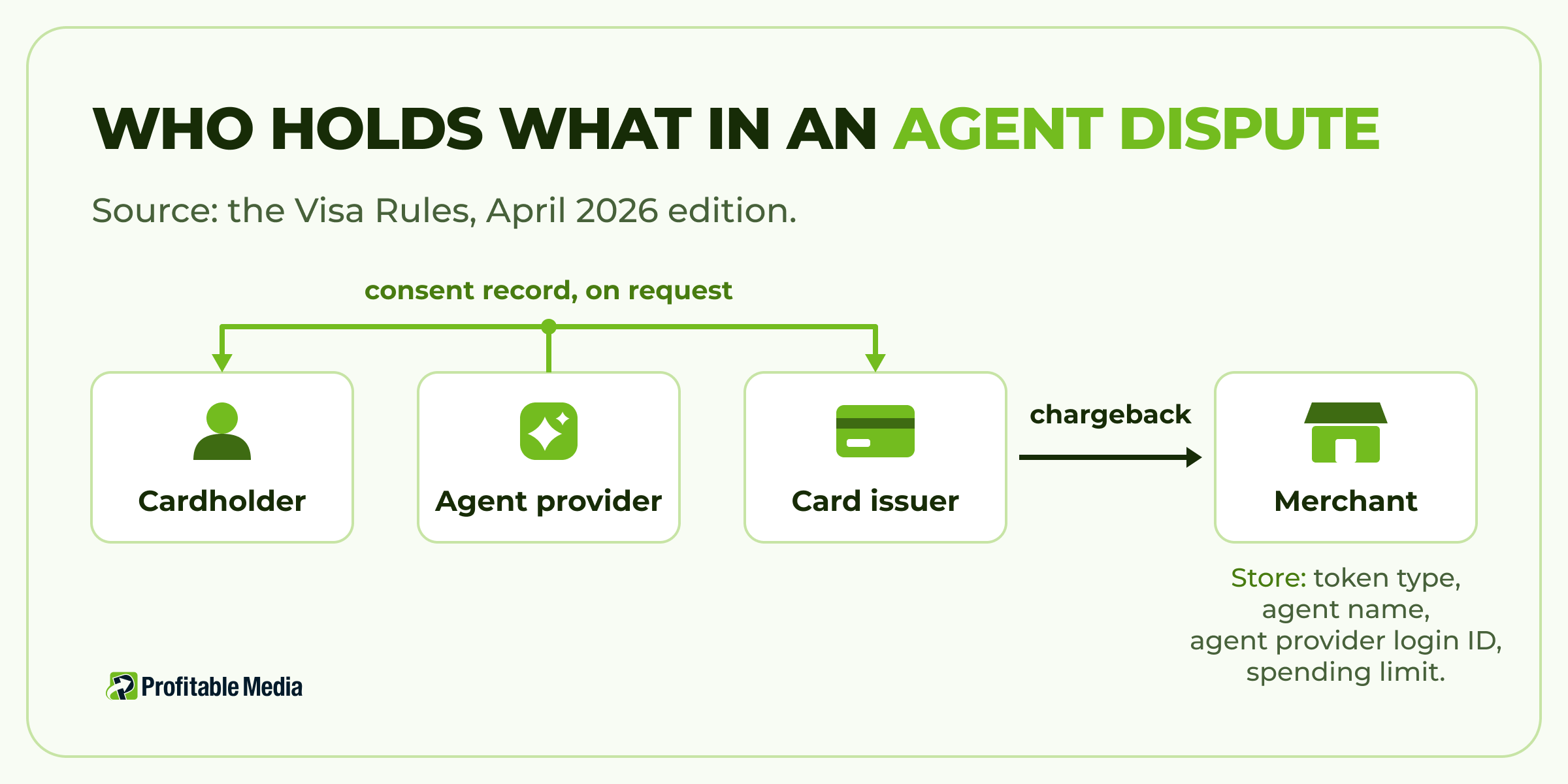
The April 2026 edition of the Visa Rules makes the cardholder responsible for what their agent does. The same rules bar a merchant from making the cardholder give up the right to dispute an agent purchase. American Express says it will protect eligible Card Members from charges that come from a registered agent’s error, and that protection covers the cardholder, not the merchant.
A merchant’s dispute evidence on an agent order has to come from the order itself. The Visa Rules require the agent provider to keep the cardholder’s consent and share it with the cardholder or the issuer when either asks in writing, and they don’t require the provider to send it to you. Mastercard describes its purchase-intent data as an audit trail for disputes. Visa’s compelling evidence rules for fraud disputes now accept an agent provider’s login ID that matches earlier undisputed orders from the same cardholder, so the login ID only helps if you stored it on every order.
What changes for trial and subscription offers?
The agent provider now holds the trial consent you would use in a dispute. Under the Visa Rules, an agent provider that stores a card for future payments must get the cardholder’s express informed consent to the terms, including the length of any trial period, and keep that record.
The merchant’s own trial duties haven’t changed. Since April 2020, Visa’s trial subscription rules have required merchants to send a reminder at least 7 days before the first full charge and to offer an easy way to cancel online. Section 4.1.24.4 of the Visa Rules requires the agent provider to pass you the cardholder’s name, addresses, and email, so send the trial reminder to that email.
Does it matter who runs your checkout?
Yes, because your checkout platform decides who sets up the agent checks. Shopify and Stripe build the agent connections for their merchants. Shopify’s Agentic Storefronts list products in ChatGPT, Perplexity, and Microsoft Copilot, and Stripe’s Agentic Commerce Suite gives its merchants one integration for several AI agents.
A brand on its own payment stack has no platform setting up those checks. In our client work, subscription and high-risk brands often run a billing platform such as Sticky.io, several merchant accounts, and routing rules between them. Nobody checks agent signatures, reads the agentic token, or stores the agent’s identity for disputes until someone sets each one up.
Every chargeback counts against the merchant account that took the payment. Craig Zahn, CMO of our client GolfKnack, described the company’s position before we rebuilt its stack: “we had outgrown our current infrastructure and started to have issues with tracking, reporting, recurring billing, our member’s area, and other roadblocks that were causing chargebacks to spike and jeopardizing our MID’s.” Agent orders add one more source of those chargebacks. We set up the merchant accounts, routing, and payment processing behind subscription and high-risk stacks, and the fraud screening in front of them.
Five things to set up before agent orders arrive
Five changes get a fraud screen ready for agent orders:
- Check agent signatures. Verify Web Bot Auth signatures for Visa’s Trusted Agent Protocol and Mastercard Agent Pay at your CDN or bot-management layer, so your screen knows which orders come from a registered agent.
- Stop declining verified agents for missing human signals. Exempt orders with a valid agent signature from rules that block on no 3D Secure, no device fingerprint, or no browsing session.
- Store the agent data with every order. Save the token type, the agent’s name, the agent provider’s login ID, and the spending limit. The agent data you store is your dispute evidence.
- Screen unsigned orders as normal card-not-present orders. Some legitimate consumer agents carry no network credentials, so run your usual checks on them, such as 3D Secure, address match, and CVV, through tools like Stripe Radar, Kount, or ClearSale.
- Send trial reminders to the cardholder’s own email. Use the email the agent provider passes you, at least 7 days before the first full charge, with a link to cancel online.
Get your fraud screening ready for agent orders
Request a free payment fraud audit. We review your fraud rules, your checkout, and your chargeback history, and show you which rules will decline agent orders or approve bots. You leave with a list of fixes in priority order, and we can set them up and maintain them for you.
Frequently Asked Questions
What is agentic commerce?
Agentic commerce means AI agents that find, compare, and buy products for people within limits the person sets. Agentic payments are the payment step.
How do agentic payments work?
The shopper tells an AI agent what to buy and sets a spending limit. The agent finds the product and gets a payment token that carries that limit. The agent sends the token to the merchant’s checkout, often with a signed identity, and the merchant charges the token through its own processor, as it would charge a card.
Are agentic payments safe?
For the shopper, an agent token exposes less than a card number, because the tokens in OpenAI’s and Stripe’s systems carry a merchant, a maximum amount, and an expiry time. A stolen token can’t pay another store. The risk moves to the merchant’s fraud screen, which has to tell a verified agent from a bot posing as one.
What is Visa Intelligent Commerce?
Visa Intelligent Commerce is the system Visa launched on 30 April 2025 for AI agents to pay with Visa cards. It gives agents tokenized cards with spending limits the shopper sets. In October 2025, Visa added the Trusted Agent Protocol, which lets merchants check that a request comes from an approved agent.
Author
Dylan Jones is Operations Manager at Profitable Media. Dylan oversees the client builds our team runs, from checkouts and billing platforms to the fraud and chargeback tools around them. LinkedIn
Sources
- Mastercard, “Mastercard unveils Agent Pay, pioneering agentic payments technology to power commerce in the age of AI”, 29 April 2025.
- Visa, “Find and Buy with AI: Visa Unveils New Era of Commerce”, 30 April 2025. Visa Intelligent Commerce.
- Google Cloud, “Announcing Agent Payments Protocol (AP2)”, 17 September 2025.
- OpenAI, “Buy it in ChatGPT: Instant Checkout and the Agentic Commerce Protocol”, 29 September 2025.
- Stripe, “Stripe powers Instant Checkout in ChatGPT and releases Agentic Commerce Protocol codeveloped with OpenAI”, 29 September 2025.
- Visa, “Visa Introduces Trusted Agent Protocol: An Ecosystem-Led Framework for AI Commerce”, 14 October 2025.
- Mastercard, “Agentic token framework: Driving trusted AI transactions”, 14 October 2025.
- Cloudflare, “Securing agentic commerce: helping AI Agents transact with Visa and Mastercard”, 24 October 2025.
- Shopify, “Introducing Shopify Agentic Storefronts: Sell your products everywhere AI conversations happen”, 10 December 2025.
- Stripe, “Stripe launches the Agentic Commerce Suite to help every business thrive in the AI-enabled commerce era”, 11 December 2025.
- Google, “New tech and tools for retailers to succeed in an agentic shopping era”, 11 January 2026. Universal Commerce Protocol.
- OpenAI, “Powering Product Discovery in ChatGPT”, 24 March 2026.
- American Express, “American Express Debuts Agentic Commerce Experiences (ACE) Developer Kit and Announces Industry-First Protection for Registered Agent Purchases”, 14 April 2026.
- Visa, “Visa Core Rules and Visa Product and Service Rules”, 18 April 2026 edition. Agentic Transaction rules (section 4.1.24) and compelling evidence for Dispute Condition 10.4.
- Stripe, “Everything we announced at Sessions 2026”, 29 April 2026.
- Mastercard, “Mastercard Advances Agentic Commerce With New Trust and Intelligence Services”, 30 September 2026.
- Google, “An intelligent new shopping cart”, 15 October 2026. Universal Cart.
- OpenAI Developers, “Delegated Payment Spec” and “Key concepts”.
- Stripe Docs, “Shared payment tokens”.
- Mastercard Developers, “Level 1 Agentic Commerce: Enable Agent Support with Minimal Changes”.
- Visa, “Subscription Merchant Transaction Policy Updates”, 18 April 2020. Trial subscription rules.