Key Takeaways
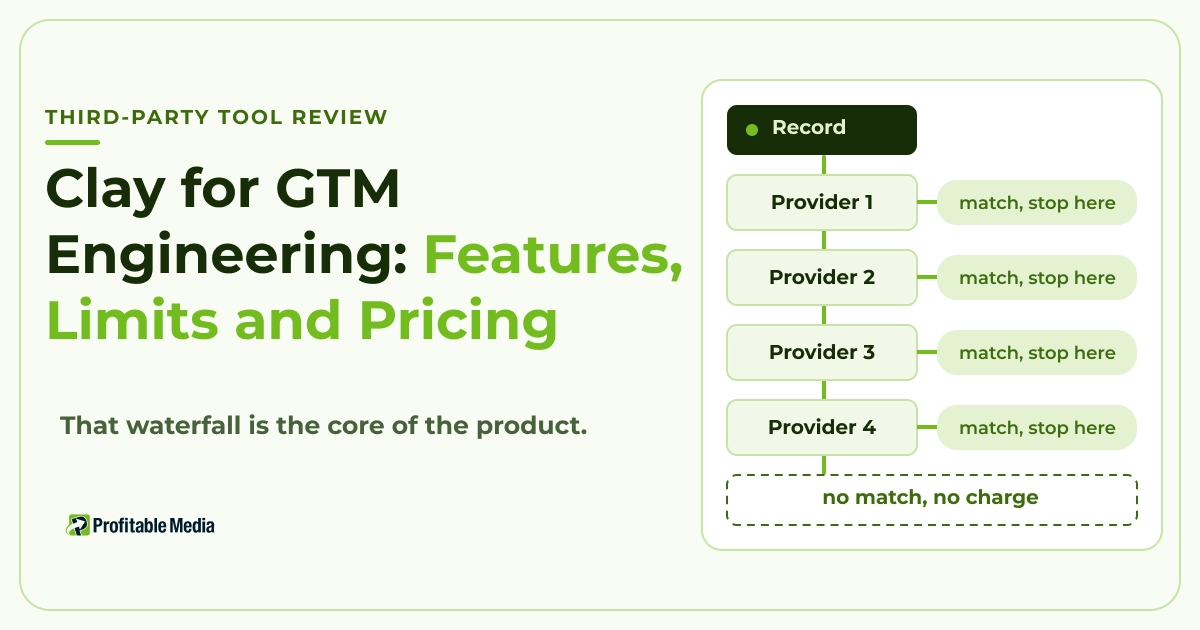
- Clay chains data providers in sequence so each record exits at the best source that can answer it. That waterfall is the core of the product.
- Clay is a tool, not a system of record. Data has to land in a CRM and stay correct there.
- Pricing runs from a free tier to Launch at $185 a month and Growth at $495. CRM auto-sync sits on Growth, which is the tier decision worth getting right.
- Clay does not publish per-provider credit costs, so test the free tier against your own list before picking a plan.
- AI coding tools make GTM scripting faster and produce code nobody can maintain unless someone owns it.
Clay is a data enrichment and list-building platform. It takes a list of companies or people, runs each record through a chain of data providers, adds AI research on top, and writes the result into your own systems.
Clay coined the term GTM engineering in 2023, which is part of why the category and the product are hard to separate. Clay is not a CRM, an attribution layer, or a place to run payment logic.
What Clay does well
- Waterfall enrichment. Clay’s guide sets out the mechanism: line several data providers up in a fixed order, send a record to the first, and if it returns a confident result you stop. If not, the record falls through to the next. No single email finder wins on both accuracy and coverage, and Clay reports that chaining them reaches roughly 80% usable coverage against 40% or 63% from individual providers.
- Ordering that controls cost. Cheap providers run on every record, and expensive specialists only fire on what nobody cheaper could match. Clay’s own worked example puts 100 records at 94% coverage for $39 with cheapest-first ordering; premium-first ordering reaches similar coverage but at a higher cost.
- Signal-based list building. Clay offers job changes, hiring posts, funding rounds, and technology installs as triggers. A recent event starts the list instead of a static filter. A company that just posted a role for the thing you sell has a reason to move that a perfect-fit account does not.
- AI research per row. Claygent, Clay’s research agent, runs a prompt against every row in a table and writes the answer back into a column.
Clay rewards iteration. You build a table, run it, throw it away, and none of that loop needs a developer.
The confidence threshold is one dial that moves quality, coverage and cost together. Strict settings reject borderline matches, which pushes more records further down the chain and costs more per contact. For cold outreach that is usually the right trade, because a wrong email costs more than a missing one.
What Clay costs
Clay bills in two currencies. Data Credits buy data from its 150-plus providers, and Actions pay for the platform work of running your tables. Each tier caps both. Clay restructured this pricing in March 2026, the figures below are from Clay’s pricing page.
- Free, $0. 100 Data Credits and 500 Actions a month, capped at 200 rows per table. You get waterfalls and Claygent.
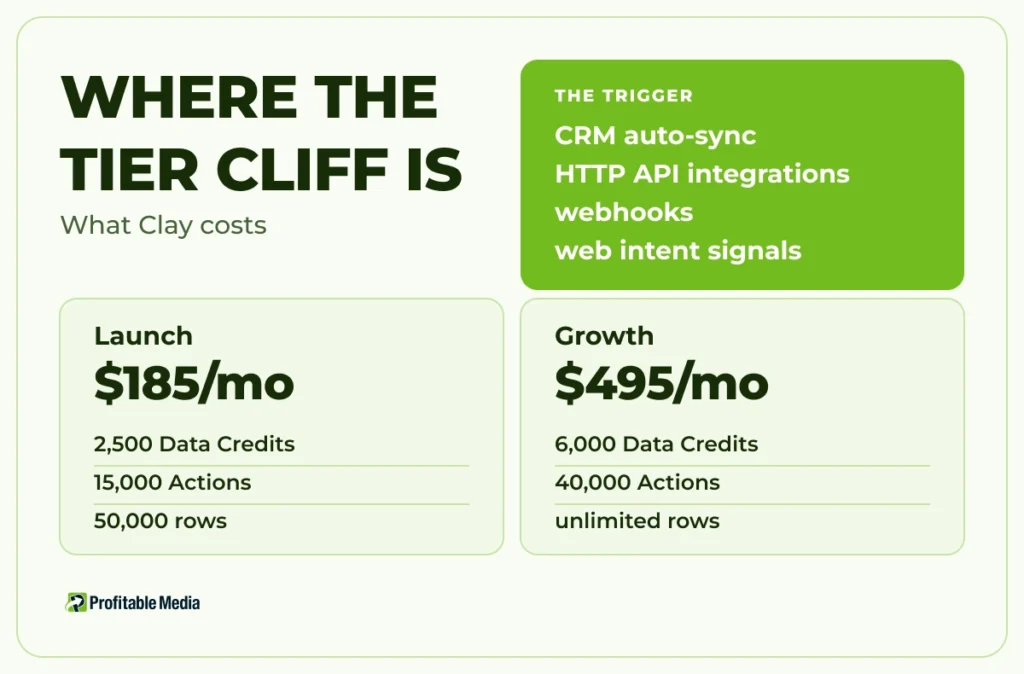
- Launch, from $185 a month. 2,500 Data Credits and 15,000 Actions, up to 50,000 rows per table. Adds phone number enrichment, job change and signal tracking, and email campaign integrations.
- Growth, from $495 a month. 6,000 Data Credits and 40,000 Actions, unlimited rows. CRM auto-sync, HTTP API integrations, webhook automation and web intent signals sit here.
- Enterprise, custom on an annual commitment. 100,000-plus Data Credits, Clay API access, data warehouse syncs, SSO and RBAC.
Data Credits start at $0.05 each and get cheaper with volume. Actions start under a cent. An enrichment that returns no result costs neither, and bringing your own provider API keys skips Data Credits so you only pay Actions.
What Clay does not publish is how many credits each provider charges per lookup, and that is the number that sets your bill. A record matched by the first provider pays for one lookup; a record that falls through five pays for five. Run the free tier against a sample of your own list and count the credits it consumes before you choose a tier, because cost per contact depends on how matchable your particular list is.
The tier decision turns on CRM auto-sync. It sits on Growth, not Launch, so once Clay has to write back into your system of record on a schedule the price is $495 rather than $185.
Three constraints on every tier
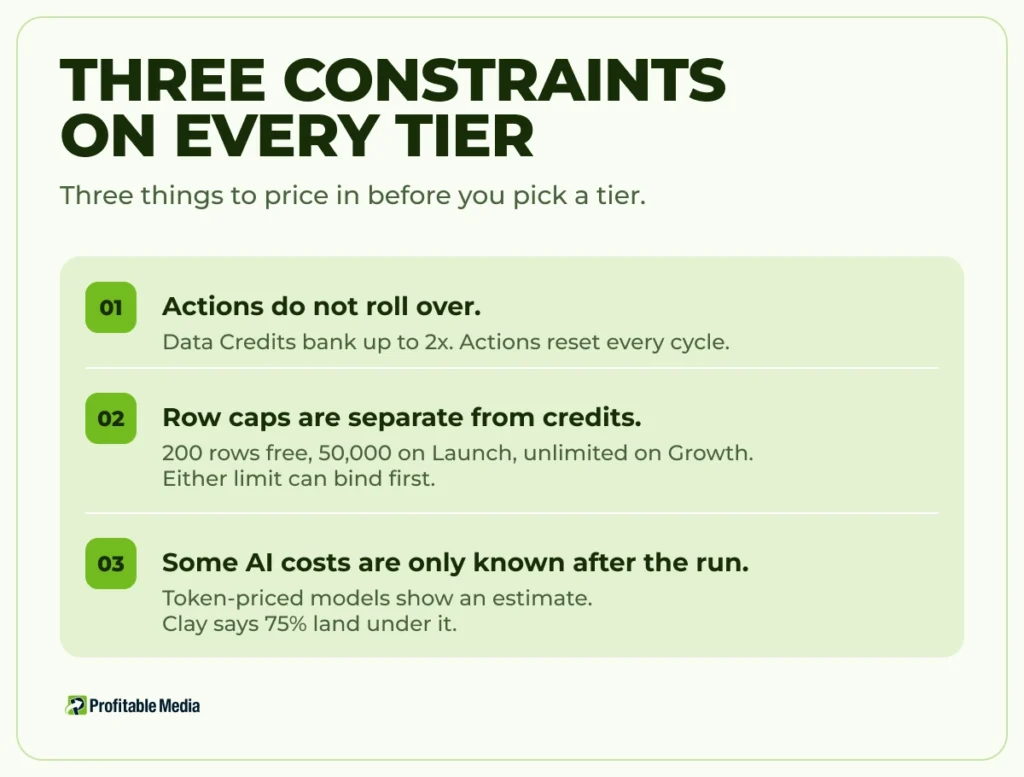
Actions do not roll over. Data Credits bank up to twice your monthly allowance on Launch and Growth. Actions reset every cycle, so a quiet month does not fund a busy one.
Row caps are separate from credits. The free tier holds 200 rows per table and Launch 50,000, with unlimited rows on Growth. A big list can hit the table ceiling with credits to spare, or burn through credits long before the ceiling.
Some AI costs are only known after the run. Clay puts 80% of its models on a flat credit rate, but token-heavy models such as GPT-5.1 and Claude Sonnet bill actual consumption and show only an estimate beforehand, marked with a tilde. Clay says 75% of those runs come in under the estimate, which leaves one in four over it.
Which tier you need
The free tier’s 200-row cap makes it a test environment. Launch, at 50,000 rows and 2,500 credits, suits one person or a small team running prospecting without needing Clay to write back into anything. Growth is the first tier that treats Clay as part of a system, because CRM auto-sync, HTTP API integrations and webhooks all live there.
So if your enrichment need is a one-off list of a few hundred records, the free tier and a spreadsheet will do. If you need Clay running on a schedule against your CRM, budget Growth from the start rather than finding out at the upgrade prompt.
What Clay does not do
Clay builds and enriches the list; it does not hold the record afterwards. A CRM keeps one authoritative row per customer with a history you can audit months later. Clay is a workspace for building, running and rebuilding tables. Use one for the other and you end up with competing answers to how many customers you have.
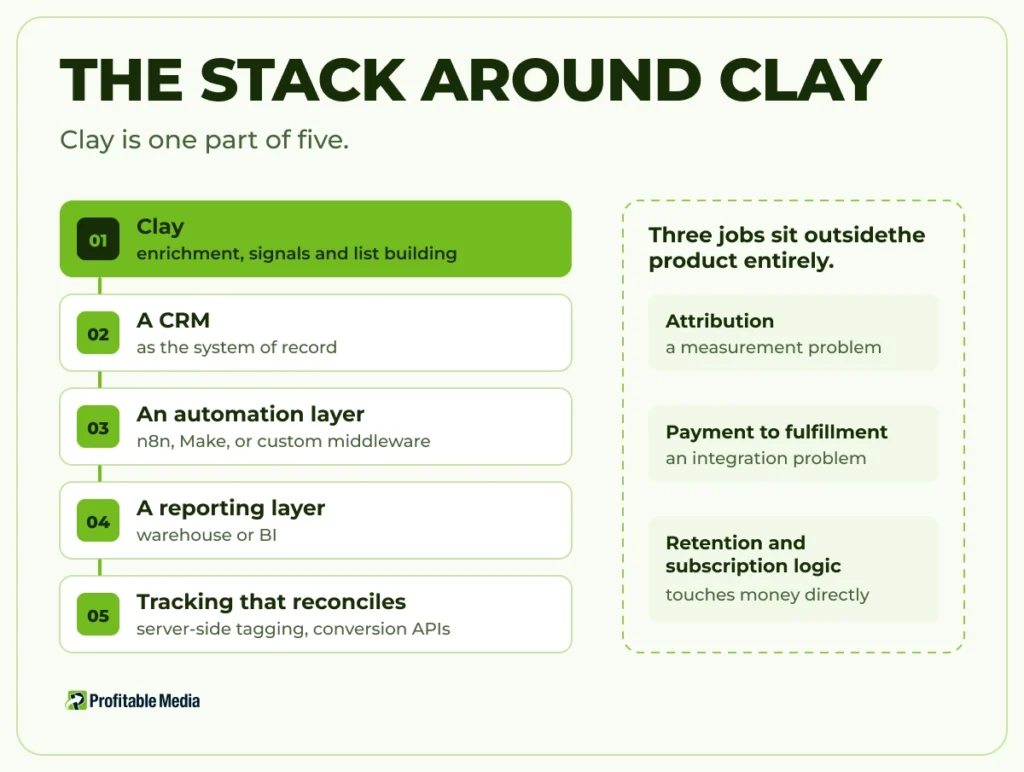
Three jobs sit outside the product entirely. Attribution is a measurement problem, because reconciling ad platform numbers against CRM numbers against the bank account turns on how each system counted, and enrichment has no bearing on that. Payment to fulfillment is an integration problem running between a processor, a store and a fulfillment system. Retention and subscription logic touches money directly, so dunning, failed-payment recovery and member access all surface as chargebacks when they break.
The stack around Clay
Clay is one part of five.
- Clay for enrichment, signals and list building.
- A CRM as the system of record. HubSpot, Salesforce, or whatever already holds your customers. It is the answer when two systems disagree.
- An automation layer. n8n, Make, or custom middleware where no native connector exists. This moves records between systems and decides what happens when a call fails: retry, and if it keeps failing, put it somewhere a human will see it.
- A reporting layer. A warehouse or BI tool that reads from the CRM, not from the enrichment tool.
- Tracking that reconciles. Server-side tagging and conversion APIs, so what your ad platforms report matches what actually happened.
Clay plus AI coding tools
AI coding tools have changed what one GTM engineer can build alone. Claude Code and its equivalents write and run the script rather than suggesting it.
They are good at bounded, one-off work. Reshaping a forty-column CRM export into what another system expects, calling an API for the first time, or writing the reconciliation between two order tables is an afternoon’s work.
The problem is ownership. Generated code runs, somebody pushes it to production, and it sits there until it breaks. By then whoever prompted it may have left, and the failure surfaces as a number that is slightly wrong rather than an error. Record what each script assumes about the shape of its input, because a renamed field upstream is what breaks it, and that assumption is the only thing that tells you where to look.
Build it yourself or have it built
Build it yourself if you have someone who writes code and owns the stack.
Have it built when the work is bounded and has to be right first time, or when an existing build has to be untangled before anything new goes on top. Untangling is the slow part, and diagnosing a stack you built yourself is harder than diagnosing someone else’s.
What to do next
Book a 30-minute GTM systems roadmap call. We review your stack, tell you what has to be built, and you leave with a scope and a price. Standard builds take 4 to 6 weeks. Complex migrations across several platforms take 8 to 12.
If you are still working out what this discipline covers, start with what GTM engineering is or the three ways to get it done.
Frequently Asked Questions
How much does Clay cost?
Clay has a free tier with 100 Data Credits a month, Launch from $185 with 2,500 credits, Growth from $495 with 6,000, and custom Enterprise pricing on an annual commitment. Credits start at $0.05 and get cheaper with volume. Clay does not publish how many credits each provider charges per lookup, so the only reliable way to price your own usage is to run a sample list on the free tier and count.
What tools does a GTM engineer use?
Clay for enrichment and signals, a CRM as the system of record, an automation layer such as n8n or Make, a warehouse or BI tool for reporting, and server-side tracking with conversion APIs. For ecommerce and subscription work add the commerce stack: sticky.io, Shopify, Stripe, MemberMouse, plus custom API middleware wherever no native connector exists.
Can Clay replace a CRM?
No. Clay tables exist to be rebuilt, which is the opposite of what a system of record needs. A CRM has to hold one authoritative row per customer, with a history you can audit. Using Clay tables as the source of truth leaves you unable to say which figure is correct when two systems disagree.
Is n8n or Zapier enough for GTM automation?
For most workflows, yes. They handle triggers, routing and moving records between systems that already have connectors. Custom work starts when two platforms have no connector, when a payment-to-fulfillment path has to handle edge cases reliably at volume, or when a failed call has to retry and reconcile on its own.
Author
Dylan Jones is Operations Manager at Profitable Media, where he works on stack selection, platform migration and funnel strategy for ecommerce, DTC and direct-response clients. Profitable Media has been building revenue infrastructure since 2008.