Key Takeaways
- GTM engineering is the practice of building and operating the systems a go-to-market team runs on: CRM architecture, data flows between platforms, workflow automation, attribution, and the payment-to-fulfillment path.
- GTM here means go-to-market, not Google Tag Manager. The two get confused constantly in search.
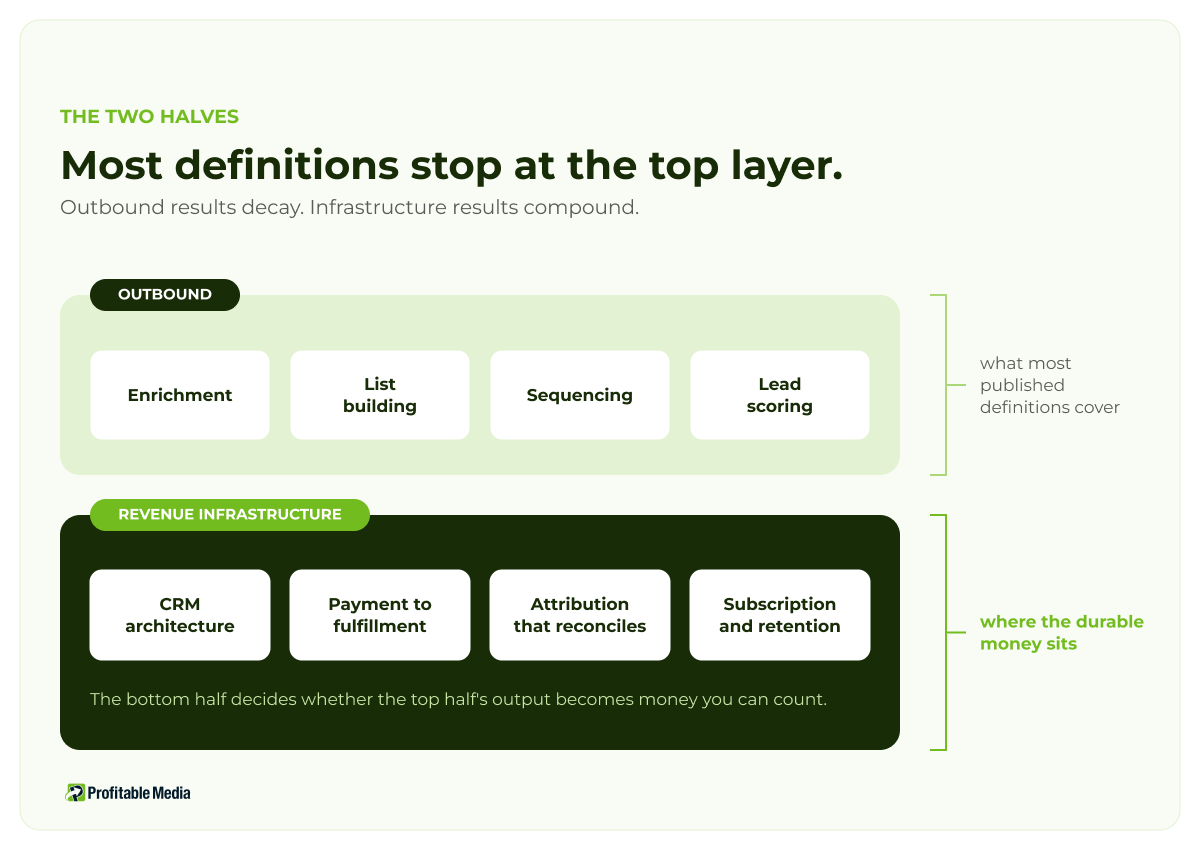
- The discipline has two halves. The outbound half (enrichment, lists, sequencing) gets almost all the coverage. The revenue infrastructure half decides whether any of it turns into money you can count.
- GTM engineering builds systems. RevOps operates and governs them. That is the cleanest line between the two roles.
- You do not have to hire a GTM engineer to get GTM engineering done.
What is GTM engineering?
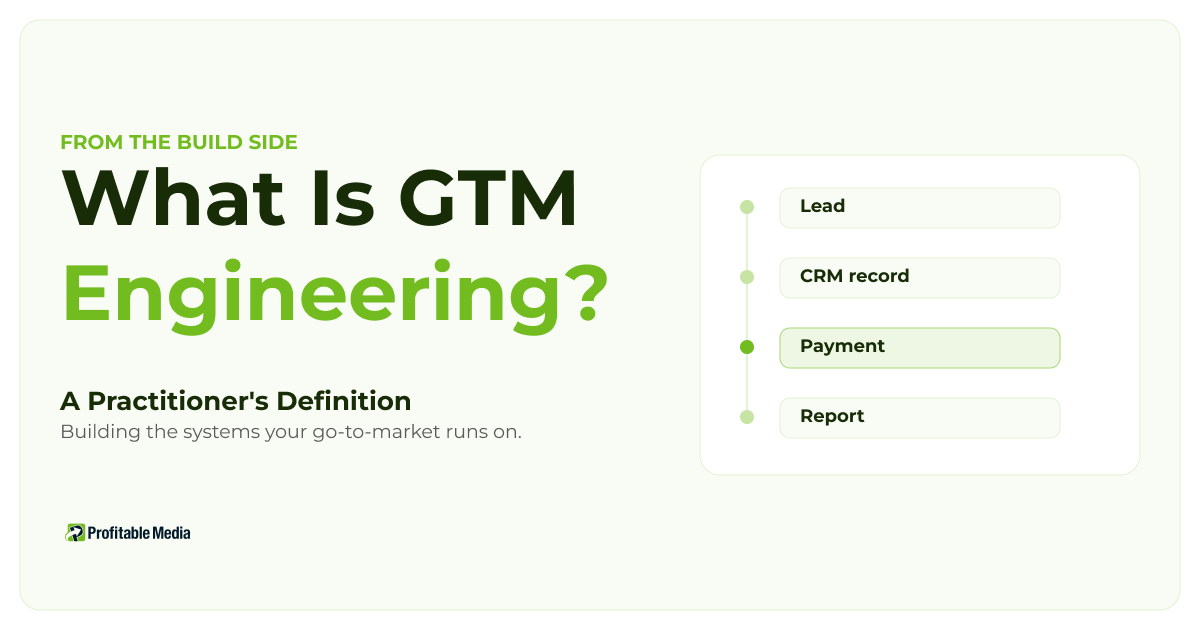
GTM engineering is the practice of building the systems, data flows, and automations that a go-to-market team runs on. Marketing, sales, and customer success all depend on software talking to other software correctly. GTM engineering is the discipline of making that happen deliberately instead of by accident.
The work sits between the platforms a company buys, the data those platforms produce, and the revenue motion the team is trying to run. Somebody has to decide how a lead becomes a record, how a payment becomes a fulfilled order, and how all of it reports back in numbers that agree with the bank account.
The role got its own name because the alternative was a pile of titles: marketing ops manager, sales ops analyst, RevOps specialist, or whoever on the growth team was technical enough to handle it. Naming it acknowledged that the job had drifted closer to engineering than to operations.
GTM here means go-to-market, not Google Tag Manager, which shares the abbreviation and shows up constantly in the same searches. The overlap causes confusion, so it is worth confirming which one somebody means early on.
What does a GTM engineer build?
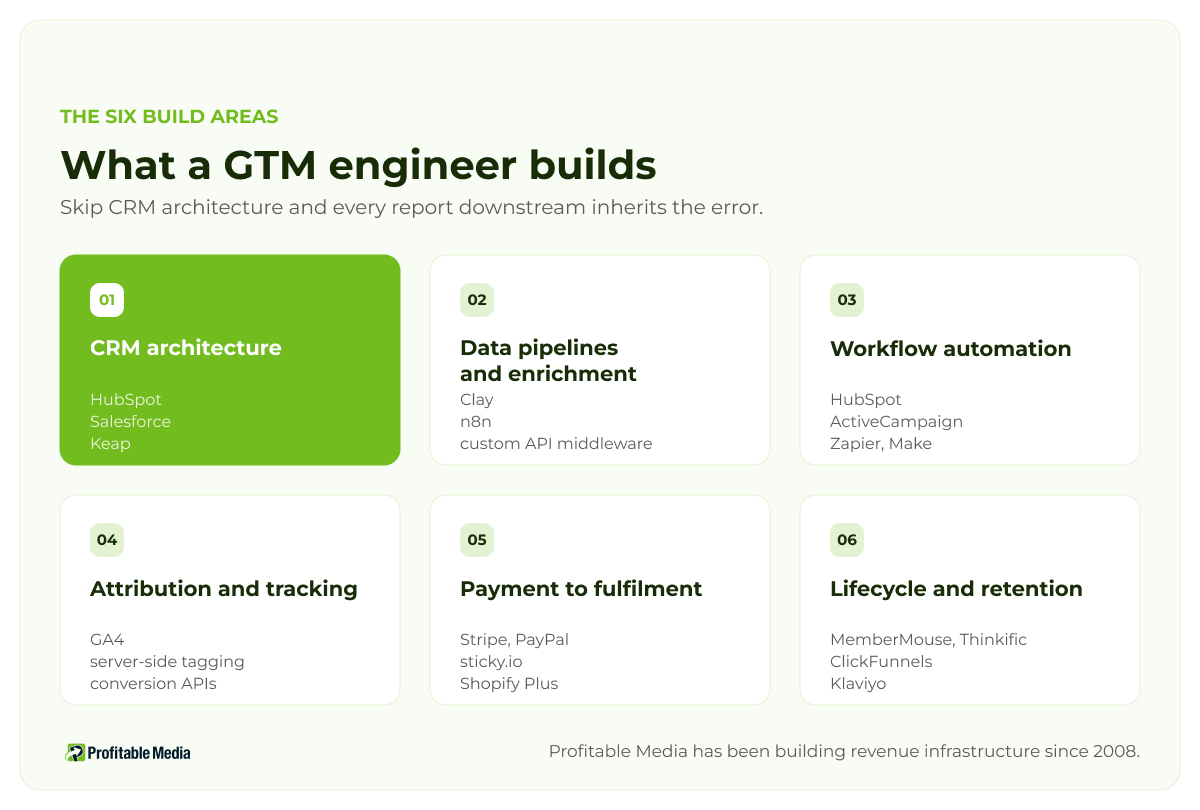
A GTM engineer builds in six areas: CRM architecture, data pipelines and enrichment, workflow automation, attribution and tracking, payment-to-fulfillment flow, and lifecycle and retention systems.
CRM architecture. The object model, the field structure, the lifecycle stages, and the rules that decide what a record means. Get this wrong and every report downstream inherits the error. It is the part that gets skipped most often, because it stays invisible right up until it fails. Our CRM and marketing automation work usually starts here even when the client comes in asking about something else.
Data pipelines and enrichment. Moving records between systems and adding to them along the way, through native connectors, workflow builders, or custom API middleware when nothing else works.
Workflow automation. Routing, scoring, assignment, follow-up and escalation, meaning every rule that has to fire correctly without anyone touching it.
Attribution and tracking. Server-side tagging, GA4 configuration, conversion APIs, and the reconciliation work that gets ad platform numbers, CRM numbers and actual revenue to agree. That last part is most of the job. Getting numbers you can act on is harder than just getting numbers.
“We met because our tracking had disparities across all our platforms. They have been able to remove all discrepancies across our tracking platform, our CRM and Google analytics. We now have numbers that allow us to make solid business decisions.”
Fran Rengel, CEO, Golden Egg Nutrition
Payment to fulfillment flow. Money moves from checkout to charge to fulfillment, and something has to write the record confirming it happened. That path usually crosses Stripe, PayPal, sticky.io, Shopify, a fulfillment house, and whatever sits between them.
Lifecycle and retention systems. Subscription logic, dunning, member access and upsell paths are what determine lifetime value, rather than just reporting on it.
We have shipped these builds on HubSpot, Salesforce, Klaviyo, ActiveCampaign, Keap, sticky.io, Shopify Plus, MemberMouse, Thinkific, ClickFunnels, Stripe and PayPal, among others.
The two halves of GTM engineering, and why you only hear about one
GTM engineering has two halves: the outbound motion on top, and the revenue infrastructure underneath it. Almost everything published about the discipline covers only the first, because that is the half tool vendors sell into.
The first half is the outbound motion. Enrichment waterfalls, signal-based list building, lead scoring, AI-assisted research at the row level, and cold email sequencing at volume.
The second half is the revenue infrastructure underneath it. CRM architecture, payment-to-fulfillment data flow, attribution that reconciles, subscription and retention logic. This half decides whether the first half’s output becomes money you can count.
Clay’s guide to GTM engineering, the post ranking first for the term, defines the discipline as building automated revenue systems with AI, data enrichment and workflow automation. Its sections cover outbound, enrichment, pipeline, hiring and team structure. Read on 8 September 2026, it contained nothing on CRM architecture, billing systems, attribution modelling, retention, or ecommerce.
Clay is a strong product doing exactly what it says, and we cover where Clay fits in a working stack separately. Everyone writing the definitions has been selling into one half of the discipline.
Outbound results decay. Infrastructure results compound. A cold email sequence that works in March is competing against everyone else’s version of the same sequence by September, because channels saturate and tactics get copied. An attribution layer that finally reconciles stays reconciled. A billing system that stops leaking continues not to leak. The second half is less interesting to write about, and it is where the durable money sits.
Which half you need depends on which problem you have. If the problem is not enough conversations, the outbound half is the answer. If the conversations are already happening and the numbers still refuse to add up, no amount of enrichment will fix that.
The obvious objection is that we are doing the same thing, defining the category to match what we happen to sell. Fair. The difference is that ours is checkable. Read the definitions ranking above this one and count how many mention billing, chargebacks, subscription logic or revenue reconciliation. If your business takes payments and has customers who churn, notice which parts of your week got left out.
GTM engineering vs. RevOps vs. marketing ops vs. sales engineering
GTM engineering builds systems that do not exist yet, RevOps governs and operates the ones that do, marketing ops runs the marketing stack day to day, and sales engineering proves the product fits a specific buyer. The line that matters most is build versus operate.
| GTM engineering | RevOps | Marketing ops | Sales engineering | |
|---|---|---|---|---|
| Core job | Build the revenue systems | Align the revenue process | Run the marketing stack | Prove the product fits the buyer |
| Builds or operates | Builds | Governs and operates | Operates | Demonstrates |
| Scope | Any system revenue touches | Process and forecast across marketing, sales, CS | Campaigns, email, automation platform, reporting | One deal at a time, pre-sale |
| Typical tools | CRM APIs, middleware, Clay, n8n, warehouses, server-side tagging | CRM, forecasting, BI | HubSpot, Klaviyo, Marketo, GA4 | Demo environments, technical documentation |
| When you need one | Something has to be built that does not exist yet | Teams disagree on numbers, stages or ownership | Campaigns ship late, reporting is thin | Deals stall on technical questions |
| Common failure | Builds something nobody else can maintain | Governs process without fixing the systems underneath | Keeps the lights on, cannot build | Great demos, nothing behind them |
In practice these overlap heavily, and at a small company one person is doing all four. Darrell Alfonso, who writes The Marketing Operations Leader, argues the org chart matters less than whether the functions are aligned, and that matches what we see. The question is whether the thing blocking you needs to be built or needs to be run, because those are different hires, different budgets, and different timelines.
What it looks like when GTM engineering is missing
When nobody owns the systems, the failures arrive together: tracking breaks, reporting inherits the error, billing fails, customers lose access to what they paid for, and chargebacks climb. The clearest description of that on record was written by a client, not by us.
“When we came to Profitable Media, we had outgrown our current infrastructure and started to have issues with tracking, reporting, recurring billing, our member’s area, and other roadblocks that were causing chargebacks to spike and jeopardizing our MID’s.”
Craig Zahn, CMO, GolfKnack, LLC
Every item on that list is a separate system failing at once, and the order matters. Tracking breaks first and quietly, so the reporting on top of it is wrong before anyone notices. Recurring billing fails next, so revenue already earned does not arrive. The member area stops granting access, so customers who paid cannot get what they bought. Each of those produces refunds and disputes, which is why chargebacks spiked.
The last item turns an annoyance into an emergency. Merchant IDs get jeopardised when a chargeback ratio climbs past what the processor tolerates, and losing them means the business cannot take payment at all. A tracking problem became an existential one in four steps, and none of them required an obvious mistake.
The failure was never dramatic. A stack quietly outgrew the way it was assembled, and nobody’s job was to notice. GolfKnack’s stack got rebuilt: new funnels, one reporting view across all traffic sources in sticky.io, and an integrated membership portal.
Do you need a GTM engineer, and does it have to be a hire?
You need GTM engineering if something in your revenue stack has to be built rather than configured, and no, it does not have to be a hire.
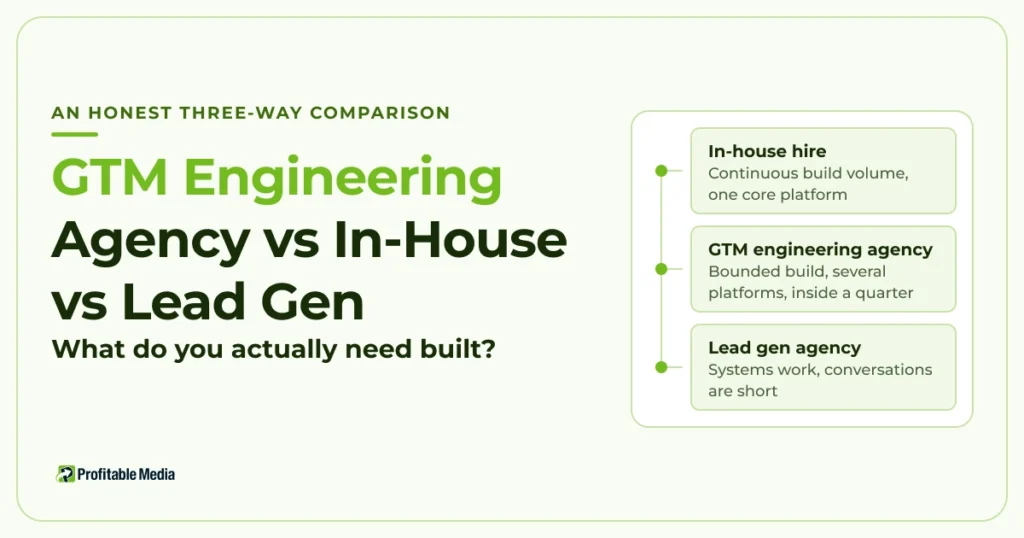
There are three ways to get it done. Hiring in-house makes sense when you have continuous build volume, one core platform, and three to six months of ramp available. An agency makes sense when the build is bounded, spans several platforms, and has to finish inside a quarter. A lead generation agency makes sense when your systems already work and the real shortage is conversations.
Most teams get this wrong in the same direction: they hire for a build that turns out to be six weeks of work, or they buy outbound to fix a problem that was never a pipeline problem.
We wrote the full three-way comparison, including in-house salary ranges and what drives agency cost, in GTM engineering agency vs. in-house vs. lead gen. If you already know you want it built for you, our GTM engineering services page covers the scope, the stack and the timeline.
Where this leaves you
The outbound half of GTM engineering matters. It also sits on an infrastructure layer that decides whether the outbound work holds.
If the half you need is the infrastructure half, read our GTM engineering services page next. It covers what a build includes, which platforms we work on, what you own at the end, and how long it takes.
Frequently Asked Questions
What is GTM engineering?
GTM engineering is the practice of building and operating the systems a go-to-market team runs on: CRM architecture, data flows between platforms, workflow automation, attribution and tracking, and the payment-to-fulfillment path. GTM stands for go-to-market. A GTM engineer builds those systems rather than operating ones somebody else built, which is the main line separating the role from RevOps and marketing ops.
What does a GTM engineer do?
A GTM engineer builds the technical systems behind revenue: CRM object models and lifecycle stages, data pipelines and enrichment, automated routing and scoring, server-side tracking and attribution, checkout-to-fulfillment integrations, and subscription or membership logic. Day to day that means API work, middleware, workflow configuration and data reconciliation. The common thread is building or connecting systems rather than operating ones that already exist.
What does GTM stand for in engineering?
In this context GTM stands for go-to-market. It is a different thing from Google Tag Manager, which is also abbreviated GTM and which appears constantly in the same searches. A GTM engineer builds go-to-market systems across CRM, data and revenue infrastructure. A Google Tag Manager specialist configures website tracking tags. It is worth confirming which one somebody means.
What is the difference between GTM engineering and RevOps?
GTM engineering builds systems. RevOps operates and governs them. RevOps owns process alignment across marketing, sales and customer success, along with forecasting, stage definitions and the shared source of truth. GTM engineering owns the technical build: APIs, pipelines, middleware and custom automation. Plenty of companies need both, and at smaller companies one person does both jobs.
Do you need to know how to code to do GTM engineering?
Not to start, but the ceiling is much lower without it. A lot of GTM engineering happens in no-code and low-code tools: CRM workflow builders, Clay, n8n, Zapier, Make. The work that requires code is custom API integration, middleware between systems with no native connector, and anything that has to handle edge cases reliably at volume. That is usually where the hardest problems live.
Author
Dylan Jones is Operations Manager at Profitable Media, where he works on stack selection, platform migration and funnel strategy for ecommerce, DTC and direct-response clients. Profitable Media has been building revenue infrastructure since 2008.
Technically reviewed by Zach Warshawsky, Chief Operating Officer at Profitable Media, with 25+ years in sales, marketing and technical architecture.